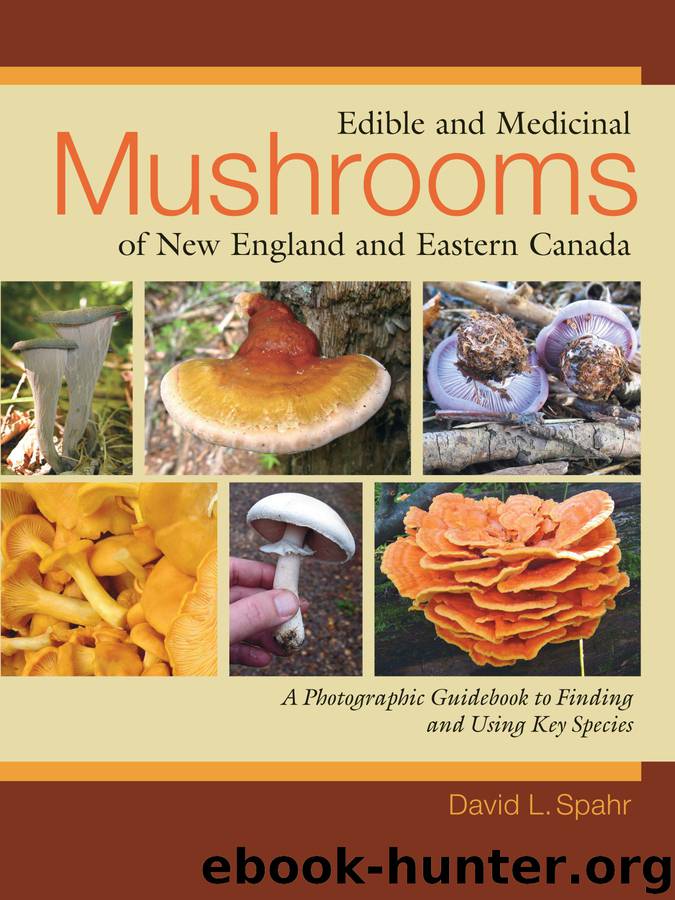
Edible and Medicinal Mushrooms of New England and Eastern Canada by David L. Spahr
Author:David L. Spahr
Language: eng
Format: epub
Tags: NAT022000 Nature / Plants / Mushrooms
Publisher: North Atlantic Books
Published: 2019-01-28T16:00:00+00:00
Figure A: Young early season Boletus edulis. Figure B: Choice-looking, fairly large Boletus edulis. Figure C: Boletus variipes. Figure D: The pores have become brownish and overmature on the larger specimen. Pores can be removed quite easily.
A mature specimen showing the yellow pores.
Chapter Thirteen
Two-Colored Bolete
(Boletus bicolor)
A cluster of Boletus bicolor.
Cap (pileus): The cap of the Two-colored Bolete ranges from two to six inches wide and from pinkish to dark red, often with some yellow tones near the margin. When young, the cap is convex, smooth, and dry with a somewhat velvety surface; as it matures, the cap flattens, often cracks, and changes to yellow-brown in color. In rare cases the cap can be yellow.
Tubes (hymenophore): The tubes may be sunken around the stalk when first opening but tend to descend the stalk as the cap opens wider. The minute, angular pores are yellow slowly bruising dark blue. The blue bruising can tend to lighten after a few minutes.
Stem (stipe): The pink or red stem can be quite thick and club-shaped, and occasionally it splits as shown in Figures A, B, and D. The stem can thin a bit and become more cylindrical as it grows with yellow tones mostly near the top.
Flesh: The flesh is strongly yellow, then slowly bruises to blue.
Spores: The Two-colored Bolete makes a brown spore print.
When and where to find them (ecology): I have found specimens between a Norway maple and a yew. The Boletus bicolor can grow in profusion, often coming up in several flushes from late June to mid-September. Mycorrhizal, the Two-colored Bolete often associates with oak and other hardwoods and usually grows separately or in small clusters. Occasionally, the B. bicolor will grow in large groups, with overlapping caps.
Preparation: This species is truly an excellent edible, ranking at least as tasty as the King Bolete (Boletus edulis). In addition to great flavor, specimens of the B. bicolor are visually appealing—real showstoppers—with their bright yellow, dense flesh that is edged in red. Younger dense specimens have a pleasant crunchy texture. Any slight bluishness tends to disappear during cooking. I have sautéed, grilled, and microwaved Two-colored Boletes with excellent results. I have also dried some; however, they do not have the pungent aroma of the King Bolete (B. edulis).
Comments: The Two-colored Bolete is one of the best-tasting mushrooms you will find. Its unique flavor is not lost in complex dishes. Versatile to cook with, this species can be mixed with many types of foods, although you would likely want to avoid mixing them with more common mushrooms, such as the White Button/Cremini/Portobello Mushroom.
Boletes with red or orange pores should not be eaten. Beginners should also stay away from any deep blue-staining mushrooms. The Two-colored Bolete bears some resemblance to the poisonous Boletus sensibilis, which immediately bruises deep blue and is more brick to cinnamon color. B. subvetipes has orange or red pores, is also poisonous, and immediately bruises strongly blue to blue-black.
Download
This site does not store any files on its server. We only index and link to content provided by other sites. Please contact the content providers to delete copyright contents if any and email us, we'll remove relevant links or contents immediately.
Inner Engineering: A Yogi's Guide to Joy by Sadhguru(6796)
The Power of Now: A Guide to Spiritual Enlightenment by Eckhart Tolle(5784)
Fear by Osho(4740)
Ikigai by Héctor García & Francesc Miralles(4275)
The Art of Happiness by The Dalai Lama(4130)
The Ultimate Bodybuilding Cookbook by Kendall Lou Schmidt(3945)
Yoga Therapy by Mark Stephens(3749)
The Little Book of Hygge by Meik Wiking(3694)
The Healing Self by Deepak Chopra(3581)
Why Buddhism is True by Robert Wright(3454)
The Hatha Yoga Pradipika (Translated) by Svatmarama(3343)
Being Aware of Being Aware by Rupert Spira(3277)
Shift into Freedom by Loch Kelly(3199)
Wild Words from Wild Women by Stephens Autumn(3153)
Work Clean by Dan Charnas(3123)
Happiness by Matthieu Ricard(3050)
More Language of Letting Go: 366 New Daily Meditations by Melody Beattie(3030)
Yoga Body & Mind Handbook by Jasmine Tarkeshi(2880)
Why I Am Not a Feminist by Jessa Crispin(2760)
